
If you’ve eaten at a Hokkien wedding banquet, a Taiwanese night market, or a home-style Chinese restaurant anywhere from Singapore to San Francisco, you’ve likely come across a plate of glossy rice vermicelli piled with pork, mushrooms, and crisp vegetables. That’s chao mifen stir-fried rice noodles one of the most quietly beloved dishes to come out of southern China.
This guide covers everything needed to make restaurant-quality chao mifen at home: cooking the noodles so they don’t turn to mush, why pre-searing the pork matters, how to layer aromatics for flavor, and how to balance the sauce. By the end, you’ll have a full recipe you can repeat on a weeknight in under an hour.
This Fujianese Dish Is a Staple Across the Chinese Diaspora
Chao mifen traces its roots to Fujian province, a coastal region long known as a hub for trade, seafaring, and migration. As Hokkien-speaking communities moved out of Fujian over the centuries, they carried their food traditions with them and rice vermicelli stir-fry became a fixture of Hokkien cooking wherever it landed.
Today, versions of this dish show up under different names and with different regional tweaks:
- Taiwan – often called mi fen (米粉), typically lighter and less saucy, tossed with pork, cabbage, and dried shrimp.
- Singapore and Malaysia – frequently folded into “Singapore noodles” or Hokkien mee variations, sometimes with curry powder or a sweeter soy glaze.
- Mainland China – regional spins exist too, from tomato-based versions in the northwest to braised, thicker-noodle interpretations elsewhere.
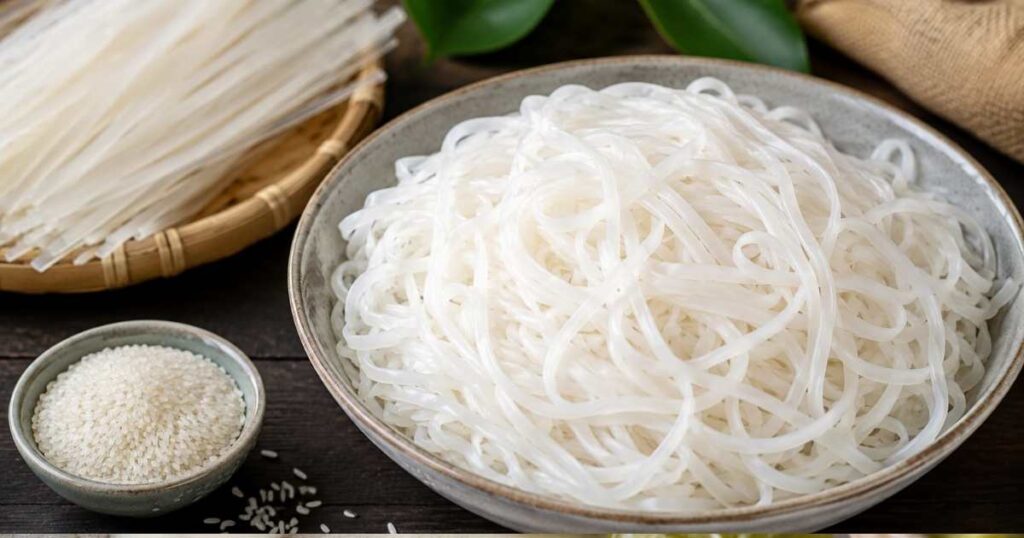
Despite the variations, the core idea stays the same: thin dried rice noodles, stir-fried hot and fast with pork, dried mushrooms, dried shrimp, and vegetables, bound together by a soy-based sauce. It’s humble, endlessly adaptable, and exactly the kind of dish that gets better the more you make it.
Perfectly Al Dente Rice Noodles
The single biggest variable in this dish isn’t the sauce or the protein it’s how you handle the noodles. Rice vermicelli is unforgiving: soak it too long and it turns mushy and falls apart in the wok; skip the soak and it stays hard and unevenly cooked.
Here’s what actually works:
- Skip the long soak. Soaking dried rice vermicelli in room-temperature water for an hour or more tends to leave the strands fragile, so they shred the moment a spatula touches them.
- Don’t go straight into the wok raw. Adding bone-dry noodles directly to a hot pan with a splash of broth often results in noodles that are cooked in some spots and stiff in others.
- Blanch briefly instead. A 45- to 60-second dunk in boiling water is enough to soften the noodles just to the edge of doneness. They’ll finish cooking in the wok, soaking up sauce without falling apart.
You’ll know you’ve nailed the texture when you can lift a forkful of noodles and the strands stay long and mostly intact, rather than breaking into short, mushy fragments.
Quick noodle troubleshooting
| Problem | Likely Cause | Fix |
| Noodles are mushy and clumped | Over-soaked or over-boiled | Blanch for 45–60 seconds only, then drain immediately |
| Noodles are stiff or chalky in the center | Not hydrated enough before stir-frying | Blanch briefly before adding to the wok, don’t skip this step |
| Noodles stick together in the wok | Not tossed with oil/aromatics fast enough | Add noodles to a hot wok with oil already coating the pan |
Pro-Tip: Pre-Cook the Pork Before Adding It to the Noodles
Most quick recipes tell you to toss raw marinated pork directly into the stir-fry with everything else. It’s faster, but it usually means the pork overcooks into dry, stringy shreds by the time the noodles are ready, and the marinade ends up diluted across the whole pan instead of clinging to the meat.
A better method: sear the marinated pork separately first.
- Heat your wok until it’s very hot, then add the pork in a thin layer so it sears rather than steams.
- Cook just until the outside is set and the pork is medium-rare about 2 minutes over high heat.
- Pull it out of the wok and set it aside while you build the rest of the stir-fry.
- Add it back in during the final minute of cooking, so it finishes gently alongside the noodles and sauce.
This two-stage approach locks in juiciness, keeps the marinade concentrated on the meat itself, and prevents the pork from turning tough by the time everything else is done.
Related Post: The Best Rougamo Bread Recipe: Authentic Chinese Flatbread Made Easy
Nailing the Aromatics in Stir-Fried Rice Vermicelli
The backbone of great chao mifen isn’t the noodles or the pork it’s the aromatic base built from dried, rehydrated ingredients. Dried shiitake mushrooms and dried shrimp are non-negotiable here. Both are dehydrated specifically because drying concentrates their flavor: shiitakes turn deeply umami, and dried shrimp develops a briny, funky intensity that fresh shrimp simply doesn’t have.
To build the aromatic base:
- Soak dried shiitake mushrooms and wood ear mushrooms in boiling water until softened, about 15 minutes.
- Soak dried shrimp separately in room-temperature water until plump, roughly 5 minutes.
- Slice the rehydrated shiitakes and wood ear mushrooms thinly so they distribute evenly through the noodles.
- Stir-fry the shrimp and mushrooms first, in oil, before adding any vegetables this step infuses the cooking oil itself with flavor.
From there, vegetables like julienned carrots and thinly sliced cabbage go in, tossed thoroughly so every piece picks up the aromatic oil before the noodles and sauce ever hit the pan.
Adjusting the Sauce
Chao mifen sauces range from light and dry to deeply saucy, and there’s no single “correct” version it comes down to personal preference and regional habit. A well-balanced sauce typically layers a few key elements:
| Sauce Component | Purpose |
| Light soy sauce | Primary savory, salty base flavor |
| Dark soy sauce | Adds color and a touch of sweetness |
| Black vinegar | Cuts through richness with acidity |
| Chicken broth | Loosens the sauce and rounds out flavor |
| Sugar and white pepper | Balances salt and adds subtle warmth |
Mix the sauce components together before you start cooking, taste it on its own, and adjust the salt, acid, or sweetness to your liking. Once you pour it into the wok, it needs to hit hot noodles immediately and get tossed fast there’s no time to adjust seasoning mid-stir-fry.
Fujian Stir-Fried Rice Noodles (Chao Mifen, 炒米粉)
Serves: 3–4 · Prep time: 25 minutes · Cook time: 15 minutes
Ingredients
For the Pork
- 7 oz (200g) pork tenderloin, thinly sliced into strips
- 1 tsp light soy sauce
- 1 tsp dark soy sauce
- 1 tsp toasted sesame oil
- 1 tsp Shaoxing rice wine
- 1 tsp white sugar
- 1 tbsp canola oil
For the Sauce
- 2 tbsp low-sodium chicken broth
- 2 tsp light soy sauce
- 1 tsp dark soy sauce
- 1 tsp black vinegar
- ½ tsp fine sea salt
- ½ tsp white sugar
- ¼ tsp ground white pepper
For the Noodle Stir-Fry
- 6 dried shiitake mushrooms
- ¼ oz (7g) dried wood ear mushrooms
- 2 tsp dried shrimp
- ¼ lb (115g) dried rice vermicelli noodles
- 1 tbsp canola oil
- ½ lb (225g) cabbage, cored and sliced
- 2 oz (60g) carrot, cut into matchsticks
Instructions
Prepare the Pork
Slice the pork thinly against the grain, then toss with the light soy sauce, dark soy sauce, sesame oil, rice wine, and sugar. Let it marinate at room temperature for 15 minutes (or refrigerate up to 2 hours).
Heat a wok over high heat, add the canola oil, and sear the pork for about 2 minutes until just cooked through on the outside. Remove and set aside.
Make the sauce: Whisk together the broth, soy sauces, vinegar, salt, sugar, and white pepper. Set aside.
Prep the aromatics: Soak the shiitake and wood ear mushrooms in boiling water for 15 minutes; soak the dried shrimp in room-temperature water for 5 minutes. Drain everything and slice the mushrooms thinly.
Blanch the noodles: Boil the rice vermicelli for 45–60 seconds until al dente, then drain.
Stir-fry: Heat oil in the wok over medium heat, add the mushrooms and shrimp, and cook until fragrant, about 40 seconds. Raise the heat to high, add the cabbage and carrots, and stir-fry until wilted, about 1 minute.
Combine: Push the vegetables to the side, pour the sauce into the center of the wok, then add the noodles and pork on top. Toss everything together over high heat until the sauce is absorbed, about 1–2 minutes. Serve immediately.
FAQs
What kind of rice noodles should I use for chao mifen?
Use thin dried rice vermicelli, not mung bean vermicelli rice noodles hold up to stir-frying, while bean-starch noodles are too fragile and will fall apart.
Can I make chao mifen without pork?
Yes shredded chicken, shrimp, or a mix of extra mushrooms and tofu all work well as substitutes for the pork.
Why are my noodles clumping together in the wok?
This usually happens when the noodles sit too long after blanching before hitting hot oil; drain them well and add them to the wok while the pan is fully heated.
Is chao mifen the same as Singapore noodles?
They’re closely related Singapore noodles are a curry-spiced offshoot of the same rice vermicelli stir-fry tradition popularized by the Hokkien diaspora.
Can I prepare chao mifen ahead of time?
You can prep the sauce, marinate the pork, and rehydrate the mushrooms a day ahead, but the noodles taste best stir-fried and served fresh.
Conclusion
Fujian Rice Noodles are simple to make at home. This Rice Noodles recipe uses easy steps. You blanch the noodles fast. You sear the pork first. You build flavor with dried mushrooms and shrimp. These Rice Noodles taste rich and savory. The sauce ties everything together.
Rice Noodles are a great meal for busy nights. You can change the veggies. You can swap the protein. The Rice Noodles stay tasty every time. Try this Rice Noodles recipe soon. Your family will love these Rice Noodles. Cook once, and you will make Rice Noodles again and again.