
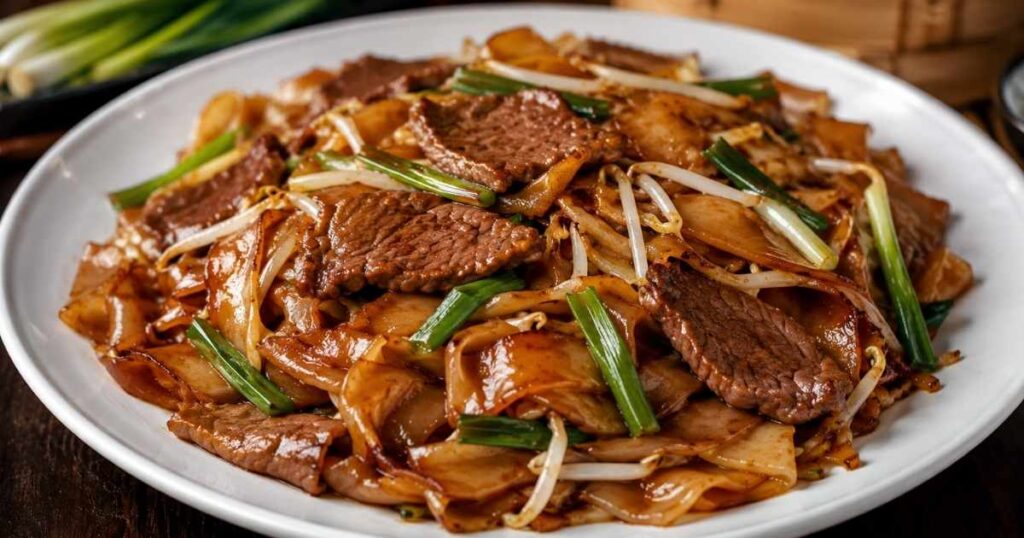
Ever bitten into a plate of beef chow fun at your favorite Cantonese spot and wondered if you could ever pull that off at home? Good news: you can. This dish looks intimidating, with its wide, glossy noodles and that faint smoky char restaurants call wok hei.
But once you understand a few key tricks, especially around the noodles, it comes together in well under 30 minutes. Below, you’ll find everything you need: what makes this dish tick, how to handle dried ho fun noodles like a pro, and a full recipe you can start cooking tonight.
Chow Fun Any Place, Any Time
Here’s the thing nobody tells you about beef chow fun: the recipe isn’t really the hard part. The noodles are. Most recipes assume you live near a Chinatown with a steady supply of fresh rice noodles, made that morning and still warm. For the rest of us, that’s simply not realistic.
So this guide flips the script. Instead of chasing down fresh noodles, you’ll learn how to turn dried ho fun into something just as satisfying. And honestly? Once you get the technique down, you’ll wonder why anyone bothers with the fuss of sourcing fresh ones.
What Is Beef Chow Fun?
Beef chow fun, known in Cantonese as gon chau ngau ho (乾炒牛河), literally translates to “dry stir-fried beef with flat rice noodles.” The dish traces its roots to Shahe, a district near Guangzhou, where the wide rice noodles used in the dish were first made. That’s why you’ll sometimes see the noodles themselves called “sha he fen” or “ho fun.”
At its core, beef chow fun combines four things:
- Thin-sliced, marinated beef (usually flank, sirloin, or skirt steak)
- Wide, flat rice noodles
- A savory sauce built on soy sauce and aromatics
- A quick, screaming-hot stir-fry in a wok
The word “dry” in the traditional name matters. Unlike saucier stir-fries, a proper chow fun shouldn’t leave a puddle of sauce on the plate. The noodles should look glossy and lightly charred, not drowning.
Fresh vs. Dried Ho Fun Noodles
This is where most home cooks hit a wall. Restaurants use fresh rice noodles almost exclusively, and for good reason: they’re pliable, they separate easily, and they pick up wok hei beautifully. But fresh ho fun has a short shelf life. Traditionally, it’s meant to be eaten within 24 hours of being made. Refrigerate it, and the sheets fuse together into an unworkable brick. Microwaving barely helps, and boiling just turns the whole mess to mush.
Unless you live within a short drive of a noodle factory, fresh ho fun simply isn’t practical on a random Tuesday night. That’s where dried ho fun earns its keep.
How to Prep Dried Noodles the Right Way
The trick isn’t complicated, but it does require a bit of precision:
- Pour boiling water (straight from the kettle) over the dried noodles.
- Soak for 3 to 5 minutes, just until they turn pliable and semi-translucent.
- Rinse under cold running water and drain thoroughly.
- Toss with a small amount of neutral oil, working it through with your fingers so the strands don’t stick together.
A short, hot soak beats a long, lukewarm one every time. Soaking too long in tepid water leaves you with noodles that are either still stiff in spots or already falling apart. Once soaked and oiled, dried ho fun behaves remarkably close to fresh, chewy, slick, and ready to take on a hard sear.
Here’s a quick comparison to help you decide which noodle route fits your kitchen:
| Factor | Fresh Ho Fun | Dried Ho Fun |
| Availability | Limited to areas near Asian markets | Widely available online and in stores |
| Shelf life | Best within 24 hours | Months, stored dry |
| Prep time | Minimal, just separate strands | 3–5 minute hot soak |
| Texture once cooked | Naturally chewy and pliable | Chewy once properly rehydrated |
| Best for | Same-day cooking near a noodle source | Pantry-friendly, cook anytime |
Choosing the Best Ingredients for Beef Chow Fun
A handful of ingredient choices separate a decent chow fun from a genuinely great one.
The beef. Flank steak is the classic choice, but sirloin, skirt, or hanger steak all work beautifully, especially sliced thin against the grain. A quick velveting marinade, baking soda, cornstarch, light soy sauce, and a touch of oil, keeps the meat tender through the high heat of the wok.
The sauce. Recipes vary here, and that’s part of the fun. Some cooks lean on light and dark soy sauce alone. Others bring in oyster sauce for body, or douchi (fermented black beans) for a deep, funky umami note. A combination of all three, rounded out with sesame oil and a pinch of sugar, gives you a well-balanced sauce that clings to the noodles without pooling underneath them.
The aromatics and vegetables. Ginger and scallions are non-negotiable. Mung bean sprouts add crunch and freshness right at the end. Some cooks also toss in bell pepper strips for color, though that’s more of a Western adaptation than a traditional touch.
The wine. A splash of Shaoxing wine, added around the edges of the wok so it flash-steams, lifts the whole dish and helps deglaze any browned bits stuck to the pan.
Related Post: Little Caesars Garlic Butter Recipe
Cantonese Beef Chow Fun Recipe
This recipe uses equal weights of beef and dried noodles, a ratio that keeps the dish balanced without leaving you short on noodles. It serves 3 to 4 people generously.
Ingredients
For the Beef Marinade
- 6 to 8 ounces top sirloin, flank, or skirt steak, thinly sliced
- ½ teaspoon baking soda
- 2 teaspoons cornstarch
- 2 teaspoons light soy sauce
- 1 teaspoon dark soy sauce
- 2 teaspoons neutral oil
For the Noodles
- 8 ounces dried ho fun noodles (about 3 bundles)
- ¼ teaspoon neutral oil
For the Sauce
- 2 tablespoons light soy sauce
- 1 tablespoon oyster sauce
- 1 tablespoon dark soy sauce
- 1 tablespoon fermented black soybeans (douchi)
- 1 tablespoon water
- 1 teaspoon toasted sesame oil
- ¼ teaspoon sugar
For Stir-Frying
- 2 tablespoons julienned ginger
- 6 scallions, halved lengthwise and cut into 2-inch pieces
- 3 tablespoons Shaoxing wine
- 6 ounces mung bean sprouts
- White pepper, to taste
- Neutral oil (about 6 tablespoons total, divided)
Instructions
- Marinate the beef. Slice the steak thinly, about ⅛ inch thick (partially freezing it first makes this much easier). Combine with baking soda, cornstarch, light soy sauce, dark soy sauce, and 2 teaspoons oil. Let sit for 30 minutes to an hour.
- Soak the noodles. Cover the dried noodles completely in boiling water and let them sit for 3 minutes. Rinse under cold water, drain well, then work in ¼ teaspoon of oil with your fingers to keep the strands separated.
- Mix the sauce. Whisk together the light soy sauce, oyster sauce, dark soy sauce, douchi, water, sesame oil, and sugar. Set aside.
- Sear the beef. Heat your wok over high heat until smoking. Add 3 tablespoons oil, swirl to coat, then add the beef. Sear briefly and stir-fry until lightly browned and just barely pink in spots. Remove to a plate.
- Stir-fry the noodles. Wipe out the wok if the beef stuck, then return it to high heat. Add 3 more tablespoons of oil and the ginger, cooking briefly until fragrant. Add the noodles, spread them out, and sear undisturbed for a moment before flipping to sear the other side. Don’t overwork them; you want them softened, not broken apart.
- Bring it together. Add the scallions, tossing gently. Pour the Shaoxing wine around the rim of the wok. Return the beef to the pan, then pour in the sauce, tossing to coat everything evenly. If things look dry or start sticking, splash in a tablespoon or two of water.
- Finish and serve. Add the bean sprouts and a dash of white pepper. Toss briefly, just until the sprouts soften slightly, and serve immediately, while it’s still hot from the wok.
Tips for Perfect Beef Chow Fun
A few small habits make a big difference between “good” and “restaurant-quality”:
- Prep everything before you turn on the heat. This dish moves fast once it starts, and there’s no time to slice scallions mid-stir-fry.
- Don’t overcrowd the wok. Too much in the pan at once traps steam, and steamed noodles turn gummy instead of seared. Use a wide, deep wok, ideally 14 inches, if you’re making a full batch.
- Handle the noodles gently. Aggressive stirring breaks the strands. Use a folding, flipping motion instead of constant tossing.
- Get the wok properly hot before adding oil or beef. A wok that isn’t hot enough is the number one reason beef sticks and noodles turn soggy instead of charred.
- Store leftovers carefully. Rice noodles don’t reheat well from the fridge; they stiffen and lose their chew. If you must save leftovers, warm them in a hot pan with a splash of water rather than the microwave.
Beef Chow Fun vs. Chow Mein
These two often get lumped together, but they’re genuinely different dishes:
| Beef Chow Fun | Chow Mein | |
| Noodle type | Wide, flat rice noodles | Thin egg (wheat) noodles |
| Gluten | Naturally gluten-free | Contains gluten |
| Texture | Chewy, slippery | Can be crispy or soft |
| Origin | Southern China (Guangzhou) | Northern China |
| Typical prep | Dry stir-fried, minimal sauce | Pan-fried, sometimes crispy-bottomed |
If you’re after that soft, chewy bite and a rice-forward flavor, chow fun is your dish. If you want crunch and a wheat-noodle base, chow mein fits the bill instead.
Beef Chow Fun Ingredients
At a glance, the core ingredient list boils down to:
- Beef (flank, sirloin, or skirt steak)
- Wide rice noodles (fresh or dried ho fun)
- Soy sauce (light and dark)
- Oyster sauce
- Bean sprouts
- Scallions
- Ginger
- Shaoxing wine
- Sesame oil and white pepper
Everything beyond that, bell peppers, garlic, extra vegetables, comes down to personal preference.
Beef Chow Fun Recipe (UK)
Cooking this in the UK? The recipe above translates directly, with a couple of substitutions worth knowing:
- Dried ho fun noodles are available at most East and Southeast Asian grocers, or online through UK-based Asian food retailers.
- Shaoxing wine can be swapped for a dry sherry if you can’t track it down locally.
- Light and dark soy sauce are both widely stocked in UK supermarkets under their Chinese cooking sections, or at any Chinese or Vietnamese grocer.
Measurements convert easily using standard UK kitchen scales; just weigh the beef and noodles in grams rather than ounces (8 ounces is roughly 225 grams).
Is Beef Chow Fun Gluten-Free?
The noodles themselves, made purely from rice flour and water, are naturally gluten-free. That said, the dish as a whole depends on your sauce. Regular soy sauce and oyster sauce typically contain wheat. If you need a fully gluten-free version, swap in tamari or a certified gluten-free soy sauce and check your oyster sauce label carefully.
Beef Chow Fun Calories
Calorie counts vary depending on portion size and how much oil is used, but a typical homemade serving runs somewhere between 500 and 600 calories, with the bulk coming from the rice noodles and cooking oil. Restaurant versions, which tend to use more oil for that signature wok hei, often land on the higher end of that range or beyond.
How to Pronounce Beef Chow Fun
“Chow fun” is pronounced roughly as “chow” (rhymes with “how”) and “fun” (rhymes with the English word “fun,” though closer to “foon” in Cantonese). In Cantonese, the dish is called gon chau ngau ho, with “ho” referring to the flat rice noodles themselves.
Beef Chow Fun Near Me
Craving it without cooking? Beef chow fun is a menu staple at most Cantonese restaurants, dim sum houses, and many general Chinese takeout spots. Searching “beef chow fun near me” on Google Maps or a delivery app will usually turn up several nearby options, especially in areas with a Chinatown or a strong Cantonese food scene.
Conclusion
Beef chow fun doesn’t have to stay a restaurant-only indulgence. With the right approach to dried ho fun noodles, a short hot soak, a cold rinse, and a light coating of oil, you can get remarkably close to that fresh-noodle texture without needing to live near a noodle factory. Pair that with thin-sliced, well-marinated beef and a sauce built on soy, oyster sauce, and a bit of umami-packed douchi, and you’ve got a dish that rivals what you’d order at your favorite Cantonese spot.
The real secret isn’t a rare ingredient or fancy equipment. It’s heat, timing, and a light hand with the noodles. Get your wok screaming hot, prep everything before you start cooking, and don’t overwork the noodles once they hit the pan. Do that, and you’ll have a plate of glossy, smoky, deeply satisfying chow fun on your table in well under 30 minutes, any place, any time you’re craving it.