
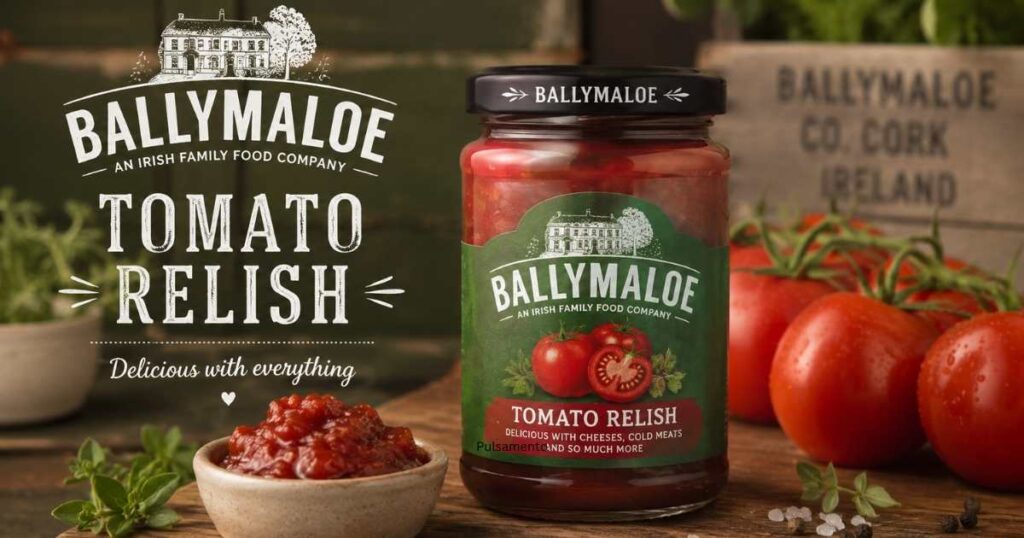
If you have ever tasted sharp Irish cheddar alongside a spoonful of deep, glossy relish and wondered what that perfect condiment was it was almost certainly a Ballymaloe tomato relish.
This iconic Irish preserve has won fans far beyond County Cork, and for good reason: it is bold but balanced, sweet but bright, and completely unlike the generic bottles lining supermarket shelves. This guide gives you the full recipe, the method, honest advice on what goes wrong, and everything you need to know about the commercial version including where to buy it, whether it is stocked at Tesco, and what gift sets are worth picking up.
What Is Ballymaloe Tomato Relish?
Ballymaloe tomato relish is a thick, slow-cooked preserve originating from the Allen family of Ballymaloe House in East Cork, Ireland. Made from ripe tomatoes, onions, vinegar, sugar, and warm spices slowly reduced until glossy and spoon-coating it sits in its own category. Unlike ketchup, it keeps texture. Unlike chutney, it is not overloaded with fruit. The commercial version, now produced by Yasmin Hyde (daughter of the legendary Myrtle Allen), has been made for over 70 years using 100% natural ingredients: 62% tomatoes, white wine vinegar, sugar, onions, sultanas, tomato puree, sea salt, mustard seed, and spices.
Think of it as Ireland’s answer to a great table sauce versatile, deeply flavoured, and suited to everything from a pork pie to a grilled cheese sandwich.
Why You’ll Love This Ballymaloe Tomato Relish Recipe
Making it at home means you control every element. Here is why it is worth the effort:
- Genuinely tastes of tomato not sugar syrup with red colouring
- No preservatives, no artificial thickeners, no corners cut
- Makes around 6 jars at once, so you are set for months
- Naturally gluten-free and adaptable for heat preference
- Pairs beautifully with cheeses, cold cuts, sausage rolls, and bacon sandwiches
- Makes an impressive homemade food gift, especially at Christmas
Ingredients That Matter (and the Ones That Don’t)
Good relish starts with honest ingredients. Ripe, meaty tomatoes Roma or plum types give the best flavour and break down properly during the long simmer. Malt or cider vinegar at 5% acidity is essential; do not substitute balsamic (too sweet and thick) or white wine vinegar (can go thin and sharp). Granulated white sugar gives a clean, consistent set. Whole yellow mustard seeds provide texture and a gentle pop. Ground cloves should be used sparingly a background note, not the headline act. Cayenne or mild chilli flakes add warmth without turning this into hot sauce.
Skip the shortcuts: no canned tomato sauces, no cornstarch thickeners, no off-brand vinegars. The relish earns its flavour through reduction, not additives.
Related Post: Placenta Smoothie Recipe: 7 Common Myths and Real Benefits
Equipment
| Equipment | Why You Need It |
| Large heavy-based pot (6–8 L) | Wide surface area speeds evaporation and prevents scorching |
| Sharp knife and board | Even cuts mean even cooking |
| Medium saucepan for blanching | For peeling tomatoes efficiently |
| Wooden spoon or heatproof spatula | Stirring without scratching the pot |
| Digital scale and measuring jug | Precision matters for sugar and vinegar balance |
| Pre-sterilised glass jars with lids | Safe preservation and long shelf life |
| Ladle and funnel | Cleaner jar-filling with less mess |
Ingredients
| Ingredient | Amount | Notes |
| Ripe tomatoes, peeled and chopped | 2 kg | Roma or plum types preferred |
| Onions, finely sliced | 1 kg | White or yellow |
| Granulated white sugar | 450 g | White for a clean set |
| Cider or malt vinegar (5% acidity) | 450 ml | Split: 225 ml now, 225 ml later |
| Fine sea salt | 2 tsp | |
| Yellow mustard seeds, whole | 2 tbsp | Do not grind keep them whole |
| Ground cloves | ½ tsp (scant) | Background note only |
| Paprika | 1 tsp | |
| Cayenne or mild chilli flakes | ¼–1 tsp | To taste |
| Cracked black pepper | ½ tsp | Optional |
Yield: approximately 1.5–1.7 litres, roughly 6 × 250 ml jars.
Method: Slow Reduction or Don’t Bother
The only real secret to a proper Irish tomato relish is time. You cannot rush the reduction. The water content in the tomatoes needs to cook off slowly, concentrating the sugars and acid into something silky and full-flavoured. Rushing it over high heat gives you scorched sugar and raw-tasting vinegar. Low and slow 60 to 90 minutes uncovered is the only method that works.
Peel the tomatoes first. Skipping this step leaves papery flecks of skin throughout the finished relish. Score the bases, blanch for 30–45 seconds in boiling water, transfer to cold water, and the skins slip off cleanly. Do not seed the tomatoes the seeds carry flavour and help with texture.
Instructions
- Peel the tomatoes. Score bases, blanch 30–45 seconds in boiling water, shock in cold water, peel. Chop roughly, keeping all the juices.
- Sweat the onions. Add onions, 225 ml of the vinegar, and salt to your heavy pot. Cook on medium-low, lid slightly ajar, for 8–12 minutes until fully translucent. Do not let them brown browned onions change the flavour profile entirely.
- Combine. Add the chopped tomatoes with their juices, remaining vinegar, sugar, mustard seeds, cloves, paprika, and cayenne. Stir to combine.
- Simmer and reduce. Bring to a gentle simmer. Skim off any foam. Cook uncovered for 60–90 minutes, stirring more frequently as the mixture thickens. You are done when a wooden spoon dragged across the base of the pot leaves a line that fills in slowly.
- Season at the end. Taste only after the sugars and acid have fully concentrated. Adjust salt. Too sharp? Give it 5 more minutes. Too sweet? Add a small splash of vinegar and simmer another 2–3 minutes. Never add more sugar to fix a thin relish reduce further instead.
- Jar it. Ladle hot relish into hot, sterilised jars, leaving roughly 5 mm headspace. Wipe rims, apply lids, and leave to cool undisturbed. Refrigerate unless you follow a tested water-bath canning process.
- Rest. Leave sealed jars for at least 48 hours before opening. Fresh relish tastes raw and loud two days of resting softens everything into the balanced preserve it should be.
Common Mistakes You Can Stop Making
| Mistake | What Happens | The Fix |
| Skipping the tomato peel | Papery skin flecks in every bite | Always blanch and peel |
| Browning the onions | Bitter caramel flavour hijacks the relish | Sweat only translucent, not golden |
| Adding sugar to fix thin relish | Cloyingly sweet mess | Reduce further; time is the fix |
| Grinding the mustard seeds | Gritty texture throughout | Keep seeds whole |
| Too much ground clove | Tastes like Christmas chutney | Scant half teaspoon maximum |
| Using balsamic vinegar | Too sweet and thick; kills brightness | Malt or cider at 5% only |
| Opening jars too soon | Sharp, unbalanced flavour | Rest 48 hours minimum |
Serving It Without Sabotage
Ballymaloe tomato relish shines best when it is allowed to do its job without competition. Classic pairings include:
- Sharp aged cheddar on rustic bread the gold standard
- Cold ham, beef, or pork slices on a cheese board
- Pork pies and sausage rolls the relish cuts through the fat beautifully
- Grilled cheese sandwiches spread it inside before grilling
- Bacon sandwiches or rolls a proper Irish breakfast upgrade
- Jacket potatoes with a generous spoonful on top
- Alongside a full Irish or full English breakfast
What it does not need: burying under mountains of mayonnaise, mixing into over-spiced burger sauces, or serving as a dipping sauce for fried food. Use it where its character can actually come through.
Storage, Maturation, and Safety
Properly sterilised, sealed jars can be stored in a cool cupboard. Once opened, refrigerate and use within 3–4 weeks, always using a clean spoon. Unopened jars are happiest in the fridge for up to 2–3 months. For pantry-stable long-term storage, follow a tested water-bath canning process rather than guessing at safety.
Never ignore warning signs: if a jar hisses on opening, smells off, or the lid has bulged, discard it without tasting. Resting the relish for at least 48 hours after making is not optional the flavour genuinely transforms as the acidity mellows and the spices integrate.
Irish Tomato Relish Recipe
Irish tomato relish has its roots in home preserving a practical way to use up a glut of late-summer tomatoes before they spoiled. The Ballymaloe style, made famous by Myrtle Allen and later championed through the Ballymaloe Cookery School co-founded by Darina Allen and Rory O’Connell in 1983, became the definitive version. What makes it distinctly Irish rather than generic is restraint: fewer spices than Indian chutneys, less sweetness than American ketchup, and a balance of acidity that makes it genuinely versatile rather than one-note. Traditional Irish cooks serve it as a table condiment year-round, not only as a seasonal preserve.
Old Fashioned Ballymaloe Relish Recipe
The old-fashioned version stays close to the original home kitchen method: everything into a heavy pot, low heat, long slow simmer, and patience. Some older adaptations include raisins or sultanas which the commercial product also uses for extra sweetness and body, and occasionally a chopped apple for pectin and mild tartness. If you want the most traditional style, add 100 g of sultanas along with the tomatoes and reduce the sugar by 50 g to compensate. This is also the version most commonly made as a homemade gift it bottles beautifully and improves with a few weeks of age.
Ballymaloe Relish Recipes
Beyond the classic, home cooks have developed several worthwhile variations using the Ballymaloe method as a base:
- Apple and tomato add 250 g finely diced apple for a slightly sweeter, fruitier relish that pairs especially well with cheese
- Spicier version increase cayenne to 1 teaspoon and add a chopped fresh red chilli for real heat
- Date version replace sultanas with chopped dates for a darker, richer flavour suited to cold meats and terrines
- Smoky version swap regular paprika for smoked paprika to create a relish that pairs perfectly with grilled meat
In all cases, the core method remains the same: low and slow reduction, whole mustard seeds, and resting time before opening.
Ballymaloe Tomato Relish Ingredients
The commercial Ballymaloe Original Relish lists its ingredients as: tomatoes (62%), white wine vinegar, sugar, onions, sultanas, tomato puree (6%), sea salt, mustard seed, and spices. The high tomato percentage is why it tastes genuinely of tomato rather than vinegar or sugar. The sultanas add gentle background sweetness and body without making it jammy. Mustard seed provides texture. The specific spices in the commercial version are not disclosed, but the flavour profile points to cloves, cayenne, and paprika as the most likely candidates which is exactly what the home recipe uses.
Ballymaloe Tomato Relish Near Me
If you want to buy Ballymaloe relish rather than make it, it is more widely available than many people realise. In Ireland, it is stocked in most major supermarkets. In the UK, Ballymaloe Original Relish is available in over 526 Tesco stores, in Sainsbury’s Irish section, and online at Ocado. In Tesco, you will find it in the chutney and pickle aisle. In Australia, it launched across 120 Coles stores. In the United States, it can be found through Irish import retailers and online food shops such as Bewley Irish Imports.
To find your nearest stockist, the Ballymaloe Foods website (ballymaloefoods.ie) has a store locator for both Ireland and the UK.
Ballymaloe Relish Tesco
Ballymaloe Country Relish is available at Tesco in both 210 g and 310 g jar sizes, produced by Ballymaloe Foods in Cork, Ireland. It sits in the chutney and pickle aisle. Once opened, the guidance is to store in a cool place and use within 6 months. The Tesco product is identical to what is sold in Ireland same recipe, same 100% natural ingredients, no reformulation for the UK market. Larger Tesco stores also carry the 490 g jar.
Ballymaloe Relish Gift Set
Ballymaloe Foods sells gift hampers and gift packs directly through their online shop, with a selection available for customers in Ireland and the UK. A typical gift set includes a selection of relish sizes often the Original Relish alongside their Smooth Relish packaged for food gifting occasions. These are popular for Christmas, housewarmings, and weddings, particularly for anyone with an interest in Irish artisan food. Homemade versions in labelled jars tied with a ribbon are equally popular as personal gifts. For trade or corporate gifting enquiries, Ballymaloe Foods has a dedicated trade section on their website.
Ballymaloe Relish
The Ballymaloe relish story began as a slow-cooked concoction of tomatoes, vinegar, sugar, and spices, perfected over years as a family table staple before it was ever served to the public. Yasmin Hyde began making her mother’s relish commercially, and the award-winning product has been made by the family for over 70 years, loved both at home in Ireland and around the world.
The brand now produces several variants: Original Relish (chunky), Smooth Relish, and seasonal or limited editions. All maintain the same core philosophy: high tomato content, 100% natural ingredients, and no shortcuts on flavour.
Notes
- Texture check: the relish should coat the back of a spoon. If it drips, keep reducing time, not cornstarch, is the solution
- Tomato choice: meaty varieties beat watery heirloom types; high water content in heirlooms prolongs cooking significantly
- Sterilisation: wash jars in hot soapy water, rinse, then dry in an oven at 120°C for 15 minutes. Fill while both the jar and relish are hot
- Scaling up: the recipe doubles well use your widest pan so evaporation is not slowed by depth
- Colour: the relish darkens as it cooks; a deep brick-red is correct. Pale relish has not been reduced enough
- Gifting: label jars with the date and suggest the recipient refrigerates after opening and uses within 4 weeks
Conclusion
A proper Ballymaloe tomato relish recipe comes down to three non-negotiables: peeling your tomatoes, sweating your onions without browning them, and reducing everything patiently until it clings to a spoon. Do those three things well, jar it hot, and rest it for two days and what you get is a condiment that earns permanent space on your cheese board and puts most shop-bought alternatives to shame.
The spices are a supporting cast, not the lead. The tomatoes are the point. Treat them with respect and the relish looks after itself.
Whether you make it from scratch or reach for a jar from Tesco, Ocado, or Ballymaloe’s own online shop, this is a condiment worth keeping in the house year-round. It pairs with almost everything savoury, keeps for months, and genuinely improves with age which puts it in rare company among kitchen staples. Once you have tasted real Ballymaloe-style relish, going back to anything else becomes very difficult indeed.